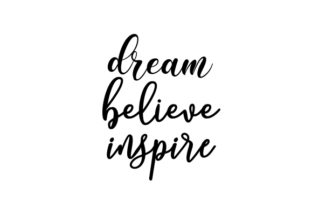
Dream, Believe, Inspire Crafts for School Amp Projects
When a client approaches me with a request for a motivational campaign centered around youth development or educational empowerment, my first instinct is to scour the creative marketplace for assets that strike the right emotional chord without feeling cliché. Recently, I evaluated the Dream, Believe, Inspire graphic design asset for a potential boutique branding project aimed at a local handmade business focusing on school supplies and artisanal crafts. The initial impression of this digital product is one of grounded optimism. Unlike many over-saturated motivational quotes that rely on overly swirly scripts or aggressive bold fonts, this design carries a visual weight that suggests stability and growth. It feels less like a temporary trend and more like a foundational element for small business branding.
Evaluating the Visual Mood for Client Campaigns
The core strength of Dream, Believe, Inspire lies in its versatility across different media formats. For the specific client project I was envisioning—a seasonal launch for a line of eco-friendly tote bags and journals—the mood needed to be inviting yet professional. This asset delivers a clean aesthetic that pairs exceptionally well with modern design trends. When placed against a neutral background, the typography and accompanying illustrative elements create a strong focal point. It avoids the clutter often found in lower-quality clipart, offering instead a refined look that elevates the perceived value of the final product.
In terms of style, it bridges the gap between a handwritten font feel and a structured display font. This hybrid approach makes it suitable for both playful Cricut projects intended for students and more polished packaging design for retail shelves. The balance of the words themselves—Dream, Believe, Inspire—creates a natural rhythm that guides the eye, which is crucial for maintaining visual hierarchy in marketing visuals.
Real-World Application in Brand Identity and Merchandise
From a practical standpoint, I tested how this graphic design asset performs in various real-world scenarios. For logo design, it serves as an excellent primary mark or a secondary badge for a brand identity system. Because the concept is universal, it works seamlessly for educational nonprofits, tutoring centers, or even lifestyle bloggers focusing on personal growth. However, its true potential shines in product mockup situations. I visualized this design on sublimation mugs, where the clarity of the lines would remain sharp, and on t-shirt designs, where the message acts as the hero graphic.
For digital sellers and print-on-demand entrepreneurs, the adaptability of this file is a significant advantage. Whether used for social media graphics on Instagram or as a Pinterest pin to drive traffic to an Etsy product page, the composition holds up well. It provides enough negative space to allow for additional text if needed, such as a website URL or a call to action, without compromising the integrity of the original illustration. Furthermore, for those creating Canva templates for teachers or parents, this asset can be dropped in as a decorative accent that instantly adds a layer of professionalism to editable layouts.
Strategic Placement and Layout Considerations
Understanding where to place Dream, Believe, Inspire is key to maximizing its impact. It excels in large layout areas where it can breathe, such as hero graphics on a landing page or the front cover of a planner. In these contexts, it acts as a powerful statement piece. It is also highly effective for themed collections, such as a back-to-school series or a New Year's resolution campaign. When used as a supporting brand element on packaging details, like a sticker seal on a box or a tag on a garment, it reinforces the brand's values subtly but effectively.
However, caution is required when deploying this asset in crowded layouts. Because the message is three distinct concepts stacked or arranged together, shrinking it down too much for small sizes can lead to legibility issues. In minimalist branding projects that require very clean visual hierarchy, one must ensure that the weight of the design does not overpower other critical information. It is not ideally suited for complex backgrounds with high-contrast patterns, as the details may get lost. For professional corporate materials that demand strict adherence to a specific style guide, this asset might be too expressive unless the brand voice specifically aligns with creative empowerment.
Technical Performance and File Format Utility
A major factor in my decision to recommend a design asset to a client is the technical quality of the files provided. The Dream, Believe, Inspire package typically includes an SVG file, Transparent PNG, EPS, and DXF. This variety is essential for a professional workflow. The SVG design is invaluable for web design and scalable vector graphics, ensuring that the image remains crisp regardless of zoom level. For crafters using cutting machines, the DXF and SVG formats are perfect for precise sticker design and vinyl cuts.
The Transparent PNG is particularly useful for quick integration into editorial design or social media posts where a vector editor isn't available. When reviewing the PNG, I always check the edges for any unwanted white halos, and in this case, the transparency appears clean, allowing for seamless placement on colored merchandise. The inclusion of EPS ensures compatibility with older vector software, a detail that speaks to the thoroughness of the design bundle.
Designer Notes for Commercial Viability
Before finalizing any asset for a commercial license project, I run a series of checks. First, I test Dream, Believe, Inspire in black and white to ensure the contrast holds up without color reliance. This is critical for single-color printing methods often used in screen printing or embossing. Next, I preview the design at both very small and very large sizes to identify any breaking points in the typography. Placing the graphic on real mockups—such as a textured paper bag or a fabric tote—helps visualize how the ink will sit on the material.
It is also vital to compare this asset against other font styles. While it has a unique character, pairing it with a clean sans serif font for body copy creates a balanced composition, whereas pairing it with another script might create visual conflict. Finally, confirming the commercial license is non-negotiable. For small business owners and digital sellers, ensuring that the commercial design rights allow for unlimited sales on physical products is the difference between a safe investment and a legal liability.
In conclusion, Dream, Believe, Inspire stands out as a robust creative design tool for those looking to infuse their projects with meaning. Whether for a School Amp initiative or a general crafts line, its ability to convey emotion while maintaining structural integrity makes it a top contender for professional use. By understanding its strengths in brand identity and respecting its limitations in complex layouts, designers can leverage this asset to create compelling, trustworthy, and emotionally resonant visual experiences.